
Blog / The Accurate Calorie Counting System That Gets Results
The Accurate Calorie Counting System That Gets Results


I hope you enjoy this blog post. If you want to apply for private 1:1 online fitness coaching with me, click here.
Author: Joey Yochheim | Founder & Head Coach of Yochheim Health Group.
Published January 13, 2026


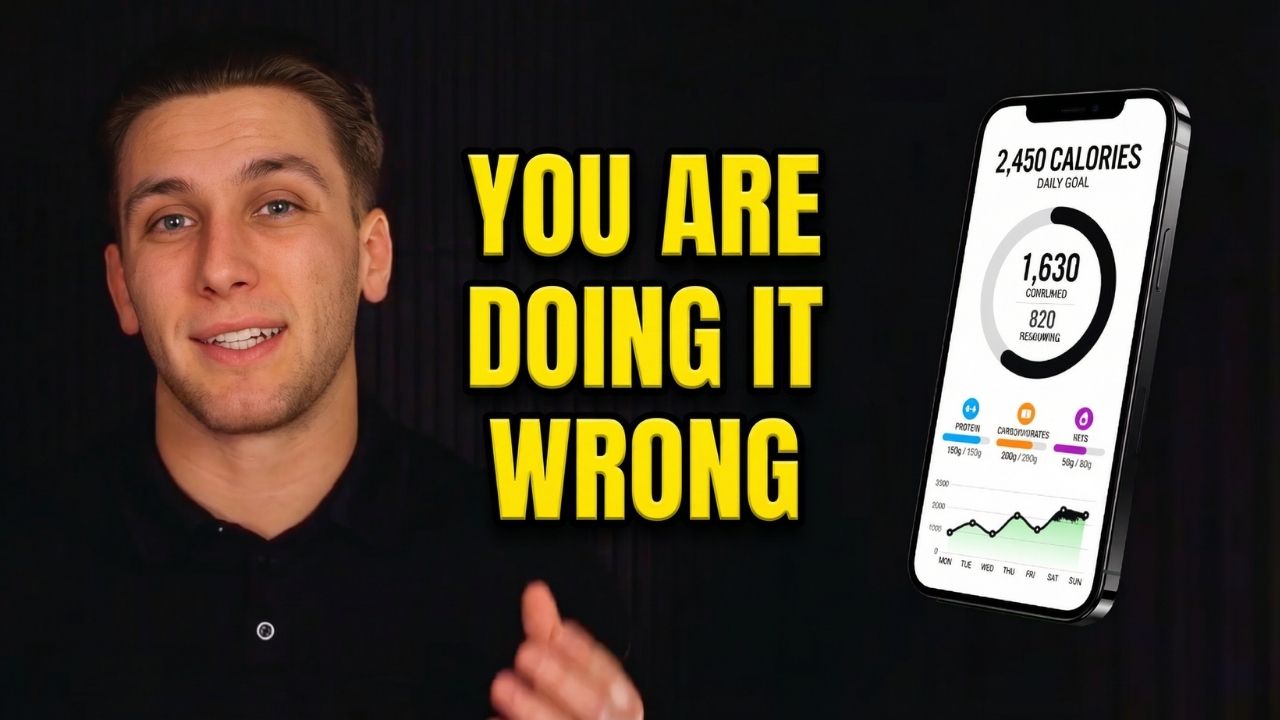
Table of Contents
Why Your Estimates Are Costing You Results
Step 1: Choose Your Tracking Tool
Step 2: Master the Barcode Scanner
Step 3: Learn to Read a Nutrition Label Correctly
Step 4: Handle Foods Without a Barcode Scan
Step 5: Track Unlabeled Foods (The Hardest Part)
The Bottom Line: Precision is a Choice

WHO IS JOEY YOCHHEIM?
Joey Yochheim is the founder of Yochheim Health Group. He is considered one of the top online fitness coaches for high-performing business owners and has the resume to back it. Joey has consistently demonstrated his expertise whether it be through his proprietary "FOS Method" that creates permanent body transformation, as well as his evidence-based approach to training and nutrition that's built on the most up-to-date scientific research and real-world application after personally coaching 1,200+ clients. He's trusted by six, seven and eight-figure entrepreneurs who refuse to sacrifice their health for their success, and has helped clients lose over 10,000 pounds collectively while building sustainable systems that last a lifetime.
You’re doing it wrong. That’s not just a clickbait thumbnail; it’s the truth. Most people who try to track their food for weight loss don’t get the results they’re after because their system is broken from the start.
As a business owner, you’re dialed in with your numbers. You track expenses, cash flow, ad spend, and revenue. You wouldn’t dream of just winging it with those metrics. But when it comes to your body and your health, you guess. You estimate. You hope. And then you wonder why nothing changes.
To date, I've personally coached over a thousand clients to a combined total of over 10,000 pounds lost. I can tell you right now, the difference between the ones who win and the ones who stay stuck is precision.
I had to learn this the hard way. As a college athlete turned weightlifter, I thought I was active enough that I didn't have to worry about my calorie intake. Four years later, I’d gained 25 pounds. I finally started tracking my food and realized I was eating 1,200 calories more per day than I thought. I literally bulked up by accident. Even as someone educated in exercise science and nutrition, I was wildly inaccurate.
That was the epiphany that caused me to become obsessed with food tracking accuracy. In this article, I’m going to break down exactly how to count calories correctly, without wasting time or letting it run your life.
Apply For Private 1:1 Online Fitness Coaching
Lose the stubborn weight and reclaim the health, energy and confidence you’ve lost - or we’ll refund you in full.
Click here to apply now

Why Your Estimates Are Costing You Results
Before we get into the system, you need to understand why accuracy is non-negotiable. A renowned 1992 study in the New England Journal of Medicine examined a group of subjects who claimed to be "diet resistant," meaning they felt they couldn’t lose weight no matter how few calories they ate.
They reported eating 1,200 calories or less per day. The study found they were actually under-reporting their calorie intake by 47% and over-reporting their physical activity by 51%. Their metabolism was normal; their reporting was broken.
The biggest contributing factor to whether or not you lose weight is your accuracy. This article will give you the system to achieve it.
Step 1: Choose Your Tracking Tool
First, you need a place to track your intake. You have two options: a spreadsheet or an app. While you can do it manually, it’s incredibly inefficient. As a busy professional, you don’t have time for that headache. Just download an app.
MyFitnessPal is the most popular and a great, beginner-friendly place to start. While our paying clients use our private, in-house app with all features included, a free app like MyFitnessPal is a perfect starting point.
Step 2: Master the Barcode Scanner
Once you have an app, the most convenient feature is the barcode scanner. Simply scan the barcode on your food packaging, and the nutrition facts will pop up. This is where most people make their first mistake: they don’t accurately report how much they actually ate.
This brings us to the most critical skill in this entire process.
Step 3: Learn to Read a Nutrition Label Correctly
1. Servings Per Container: Many people eat an entire package of something and assume the calories listed are for the whole thing. But if the label says "8 servings per container," you need to multiply the calories by eight. That 230-calorie snack just became an 1,840-calorie meal.
2. Serving Size: The label will define a serving size, usually in a common measurement (e.g., “2/3 cup”) and in grams (e.g., “55g”). This is not a suggestion; it’s the unit of measurement for all the nutritional information provided.
To do this right, you must physically measure your food. Do not eyeball it. I’ve worked with thousands of clients, and even with years of experience, I can’t eyeball portions accurately. You need to use a food scale or measuring cups.
Using a food scale is the most precise method. Place your bowl on the scale, zero it out, and add the food until it reaches the gram weight listed for the serving size on the label. This removes all guesswork.

Step 4: Handle Foods Without a Barcode Scan
What happens if you scan a barcode and the item doesn’t show up in the app’s database? You have two options.
1. Search the Food Library Properly
First, try searching for the item manually. The key is to be hyper-specific. Don’t just search for “egg whites.” Search for “Simple Truth Organic Cage-Free 100% Liquid Egg Whites.” The more details you include—brand, type, flavor—the more likely you are to find an accurate match. Cross-reference the nutrition facts on the app with the label on your product to confirm you’ve found the right one.
2. Create a Custom Food Entry
If you can’t find a match, create a custom food item in your app. You’ll need to manually enter the information from the nutrition label:
• Serving Size (e.g., 2/3 cup or 55g)
• Calories
• Protein
• Carbohydrates
• Fat
Nail these five metrics. While other micronutrients are important for overall health, these are the ones that will determine your success in weight loss.
Join our newsletter
Real Coaching Insights, Delivered 3x Per Week, Read in Under 60 Seconds. Join 4,000+ subscribers reading “The Weigh-In”. A fast, action-packed newsletter featuring real insights pulled straight from live coaching calls with Joey Yochheim.
Click here to SUBSCRIBE
Step 5: Track Unlabeled Foods (The Hardest Part)
What about foods without any label at all, like meat from a butcher, produce from a farmer’s market, or a meal someone else cooked for you? This is where most people throw their hands up, but you can still be precise.
First, gather as much information as you can. For meat, the cut and fat percentage are critical. 70/30 ground beef has a completely different calorie profile than 93/7 ground beef. A ribeye steak is not the same as a filet. Chicken thighs are not chicken breasts. Skin-on is not skinless. Grilled is not fried. Details matter.
Next, use your food scale to weigh the portion you are eating. Once you have the weight (e.g., “6 ounces of 93/7 ground beef, cooked”), you can leverage AI or Google.
Prompt an AI tool like ChatGPT or search Google with a hyper-specific query: “On average, what are the calories and macros for 6 ounces of cooked Kirkland brand 93/7 ground beef?”
This won’t be perfect, but it will be far more accurate than guessing. The more specific your prompt, the better your estimate will be.
The Bottom Line: Precision is a Choice
Look, I understand you might want an over-the-shoulder, day-in-the-life video showing you exactly how I do this. However, I reserve that level of detailed implementation for my paying clients. It would be disrespectful to them to give away the entire system for free.
Furthermore, the nuances of your specific apps, scales, and shopping habits would make a generic video more confusing than helpful. The principles I’ve laid out in this article are the foundation. Your job is to apply them with precision.
Stop guessing with your health. You have the tools and the system. Now, it’s time to execute.
Watch The Video:
ABOUT THE AUTHOR
Joey Yochheim is the founder of Yochheim Health Group. He is considered one of the top online fitness coaches for high-performing business owners and has the resume to back it. Joey has consistently demonstrated his expertise whether it be through his proprietary "FOS Method" that creates permanent body transformation, as well as his evidence-based approach to training and nutrition that's built on the most up-to-date scientific research and real-world application after personally coaching 1,200+ clients. He's trusted by six, seven and eight-figure entrepreneurs who refuse to sacrifice their health for their success, and has helped clients lose over 10,000 pounds collectively while building sustainable systems that last a lifetime.
Connect With Me: